Case study · 2023—25
A research practice, built from zero
Time Doctor had no consistent research practice. I built the infrastructure that made user research repeatable, findable, and part of everyday product decisions.
01 · The situation I inherited
Research was happening. Organizational knowledge wasn't.
Research existed across Customer Success, Product and Design, but there was no shared process or place for it to live. Studies were hard to find, impossible to connect, and their influence on product decisions was largely invisible.
Every project effectively started from zero.
02 · Researching the research process
I didn't start by imposing a framework. I treated the research practice itself as a research problem — auditing what existed, who was doing it, and how teams actually worked.
What the audit revealed
There was more research than expected, but almost none of it was reusable. I even found teams running near-identical studies without knowing the other research existed.
Established practice, adapted
I used Nielsen Norman Group and Atomic Research as foundations, then adapted them to a distributed company without a dedicated research function. The principle I kept was simple: research should produce evidence that outlives the study.
- 01Audit every study, doc and recording I could find, wherever it lived
- 02Identify who was doing research, including people who didn't call it that
- 03Interview Product, Customer Success, Design and Engineering
- 04Assess where UX maturity actually was, not where a model says it should be
- 05Map what was missing against what was only hard to find
- 06Review established practice and test it against how this company works
03 · The intervention
I wasn't trying to build a research repository. I was building a system that made research reusable.
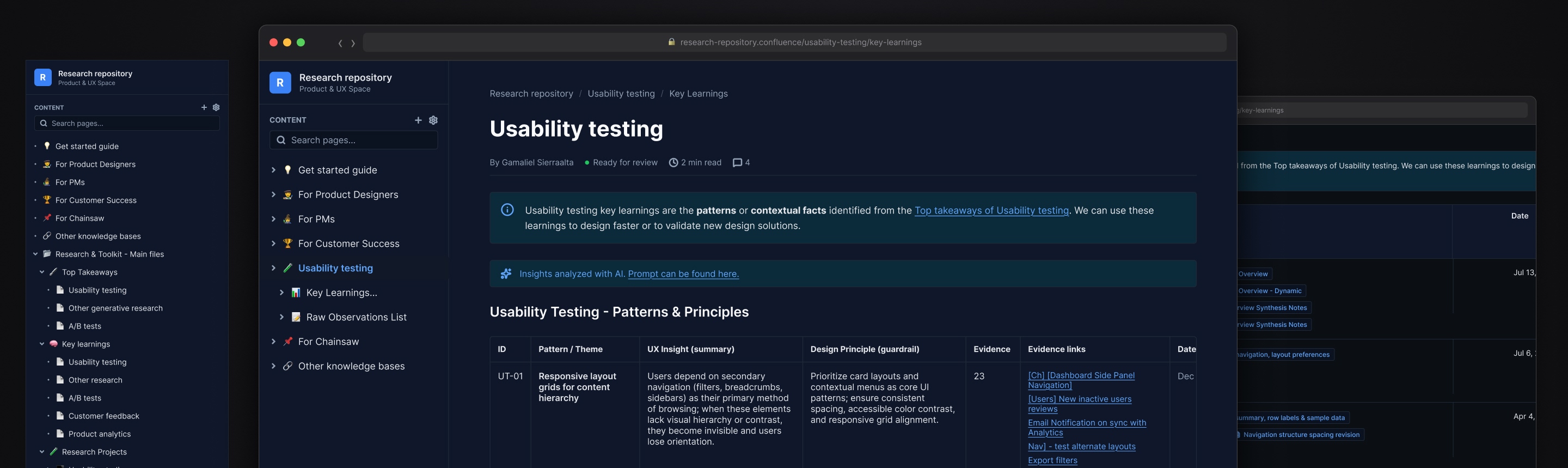
The repository brought the research into one place, with a taxonomy decided in advance rather than reinvented for every study.
The repository isn't the framework
On its own, a repository is just a folder. The system around it is what makes it useful: templates standardize what goes in, a Customer Success partnership makes recruitment faster, and a communication loop gets findings back into product decisions.
Confluence was the container because Confluence is where the company already worked. Picking a better tool nobody opens would have been the same mistake in a nicer interface.
What the system is made of
- Standardized methods
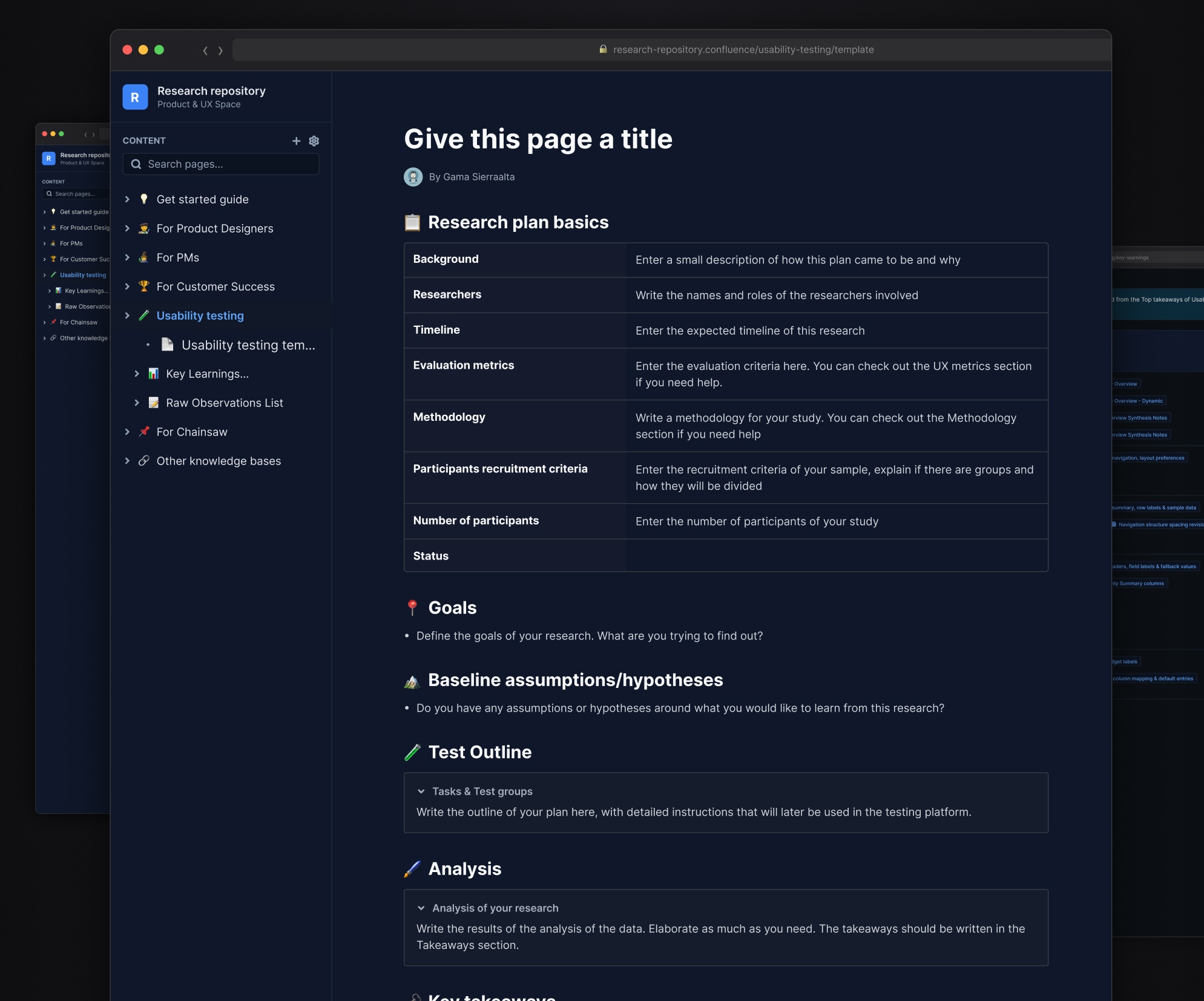
- Research templates
- Recruitment pipeline
- Usability testing tools
- Repository taxonomy
- Stakeholder communication
04 · The framework
Five stages, with the fifth feeding back into the first.
-
01
Discovery
Understand what we know, what we don't, and where the existing evidence lives.
-
02
Synthesis
Turn research into consistent, comparable structures.
-
03
Insights
Extract evidence that informs product decisions and reveals recurring patterns.
-
04
Communication
Make findings usable beyond the people who ran the study.
-
05
Evolve & Improve
Evaluate the system itself, and adopt better methods, tools and — increasingly — AI.
Continuous improvement
Evolve & Improve keeps the framework from becoming a frozen 2023 process. It's why AI is part of the system today even though it wasn't when I built it.
05 · The repository
-
01
Predictable taxonomy
Someone who didn't run the study can still find it.
-
02
Standardized study structure
Research follows a recognizable pattern instead of every designer inventing their own format.
-
03
Traceable evidence
A finding keeps the link back to the raw material it came from.
-
04
Reusable knowledge
Old research becomes input for new product work instead of disappearing after the presentation.
The structure is intentionally boring: predictable enough to survive people changing teams, projects ending, and years passing.
06 · The framework in practice
The framework gives designers and PMs a default research method for the question in front of them.
- Understand a problem
- Generative research
- Understand the user
- Personas — and synthetic personas where the real sample was too thin
- Understand an experience
- Journey mapping
- Validate usability
- Unmoderated tests on Lyssna, moderated sessions on live prototypes
- Compare two options
- A/B testing
- Find what we already know
- The research repository
Tools can change — Useberry became Lyssna, for example. The important part is having a default process, not allegiance to a tool.
End to end on a product that shipped
Benchmarks AI put the full system to work, from first hypothesis to live MVP and back into the repository.
The framework wasn't documentation about how research should happen. It became the infrastructure behind how we actually built products.
07 · AI enters the framework
The repository became more valuable as AI improved. Years of consistently structured studies gave us something worth analyzing across research, rather than one transcript at a time.
AI now looks for recurring themes across studies and turns them into small, attributable, reusable research facts. The biggest gain isn't synthesis speed — it's being able to ask a different kind of question.
What did that study tell us?
What have our users consistently told us about this?
Related explorations · Synthetic personas · Journey extraction
08 · What changed
What changed wasn't how much research we did. It was what got to settle a disagreement: evidence instead of opinion.
Product questions can now often be put to real users and answered in under 24 hours.
Before
- Research scattered across teams
- Every study in its own format
- Slow, ad-hoc customer recruitment
- Insights disappear once the project ends
- Product disagreements settled internally
After
- One repository the whole company uses
- Reusable research standards and templates
- A standing Customer Success ↔ Product recruitment channel
- Persistent, searchable evidence
- User testing available as a decision-making tool
- AI-assisted synthesis across studies
The evidence should outlive the project — and the person who collected it.
I've watched people I've never worked with use studies I ran in 2023 to make a case for something I had no opinion about.
That's the outcome I care about: research becoming cumulative knowledge — evidence that keeps working after the project ends or the person who gathered it moves on.
Screens are mockups or sanitized · No customer or employee information